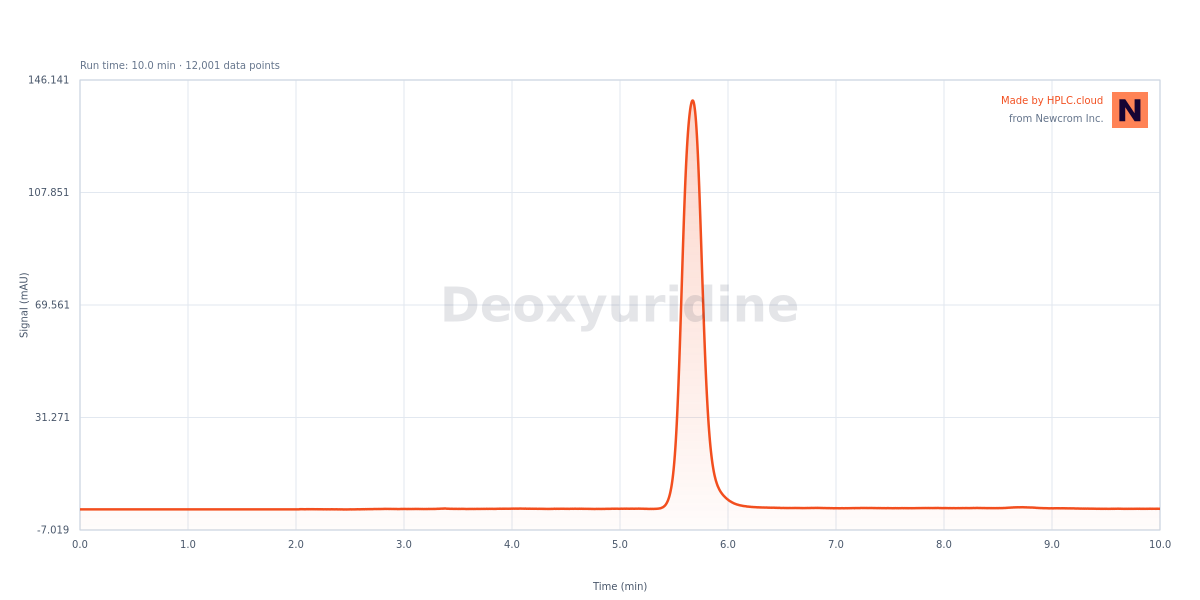
HPLC Method for Analysis of Deoxyuridine on Alltesta™ Gradient
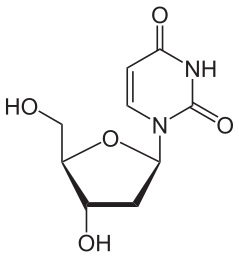
Deoxyuridine (dU) is an nucleoside with the C9H12N2O5 molecular formula. While in living organisms it exists primarily to occasionally become a part of DNA, it’s variants, Idoxuridine and Trifluoride, work as antiviral drugs. If consumed, Deoxyuridine can be toxic. Deoxyuridine can be retained and analyzed using the Chromni™ stationary phase column. The analysis utilizes an isocratic method with a simple mobile phase consisting of water and acetonitrile (MeCN) with phosphoric acid as a buffer. Detection is performed using UV.
Frequently Asked Questions: HPLC Method for Analysis of Deoxyuridine on Alltesta™ Gradient
What analyte does the HPLC Method for Analysis of Deoxyuridine on Alltesta™ Gradient cover?
The HPLC Method for Analysis of Deoxyuridine on Alltesta™ Gradient is designed for Deoxyuridine, a nucleotide base compound. Deoxyuridine (dU) is an nucleoside with the C9H12N2O5 molecular formula.
Which column and mobile phase are required for Deoxyuridine analysis?
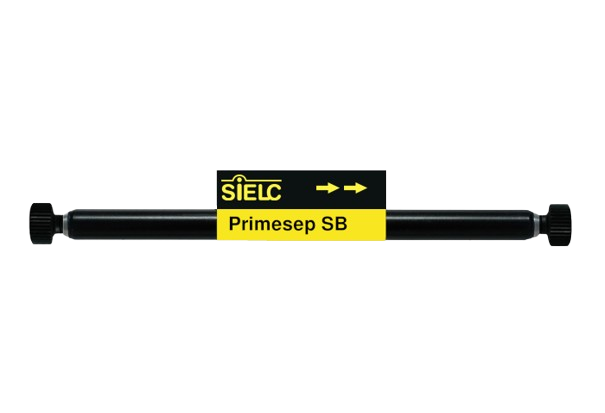
Run the separation on Chromni™ (4.6 x 150 mm, 5 um, 100 A, dual ended), SKU CHR-46.150.0510. Typical mobile phase: MeCN, 90% 90% AmFm pH 3.0 - 30 mM; H2O 10%.
What instrument conditions should I use for the HPLC Method for Analysis of Deoxyuridine on Alltesta™ Gradient?
Operate on Alltesta™ Gradient with 275 nm. Flow rate: 1. Injection volume: 10. Run time: 10.