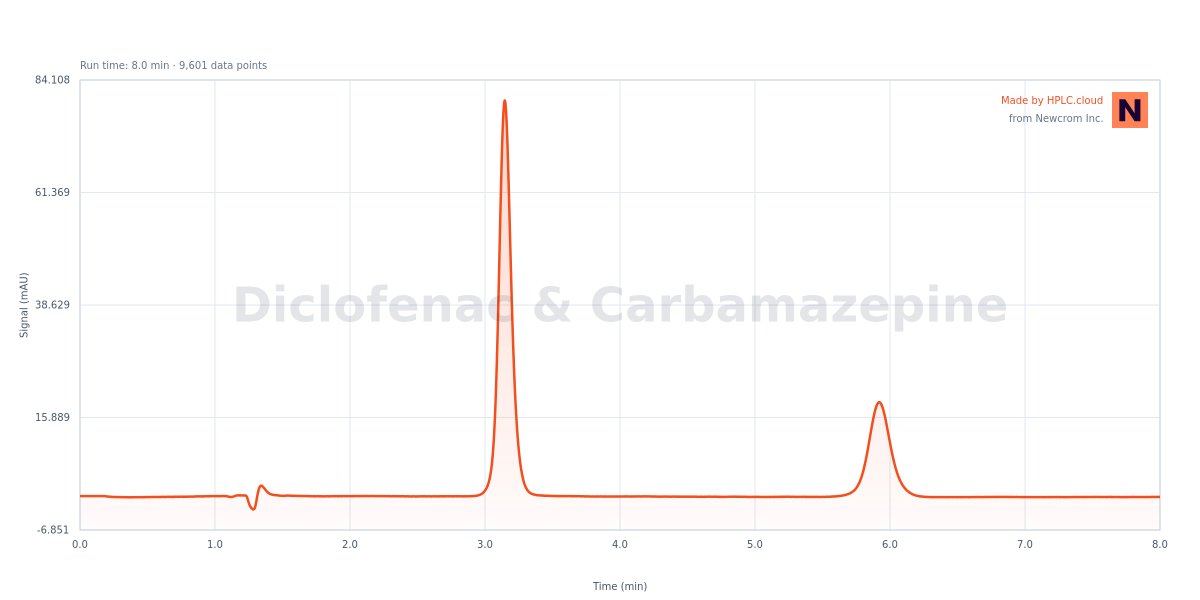
HPLC Method for Analysis of Diclofenac & Carbamazepine on Alltesta™ Gradient
Diclofenac is a nonsteroidal anti-inflammatory drug (NSAID) with the molecular formula C14H11Cl2NO2. It is a pain killer that also relieves symptoms of arthritis. It is only accessible through a prescription from a medical professional. Carbamazepine is a anticonvulsant medication with the molecular formula C15H12N2O. It is typically used to treat epilepsy, bipolar disorder, and nerve pain. It works through calming overactive nerves through binding voltage-dependent sodium channels. Diclofenac, Carbamazepine can be retained and analyzed using the Primesep 100 stationary phase column. The analysis utilizes an isocratic method with a simple mobile phase consisting of water and acetonitrile (MeCN) with a sulfuric acid buffer. Detection is performed using UV.
Frequently Asked Questions: HPLC Method for Analysis of Diclofenac & Carbamazepine on Alltesta™ Gradient
What analyte does the HPLC Method for Analysis of Diclofenac & Carbamazepine on Alltesta™ Gradient cover?
The HPLC Method for Analysis of Diclofenac & Carbamazepine on Alltesta™ Gradient is designed for Diclofenac & Carbamazepine, a drug compound. Diclofenac is a nonsteroidal anti-inflammatory drug (NSAID) with the molecular formula C14H11Cl2NO2.
Which column and mobile phase are required for Diclofenac & Carbamazepine analysis?
Run the separation on Primesep 100 (4.6 x 150 mm, 5 um, 100 A, dual ended), SKU 100-46.150.0510. Typical mobile phase: MeCN, 35% 35% H2SO4, 0.2%; H2O 65%.
What instrument conditions should I use for the HPLC Method for Analysis of Diclofenac & Carbamazepine on Alltesta™ Gradient?
Operate on Alltesta™ Gradient with 275 nm. Flow rate: 1. Injection volume: 2. Run time: 8.