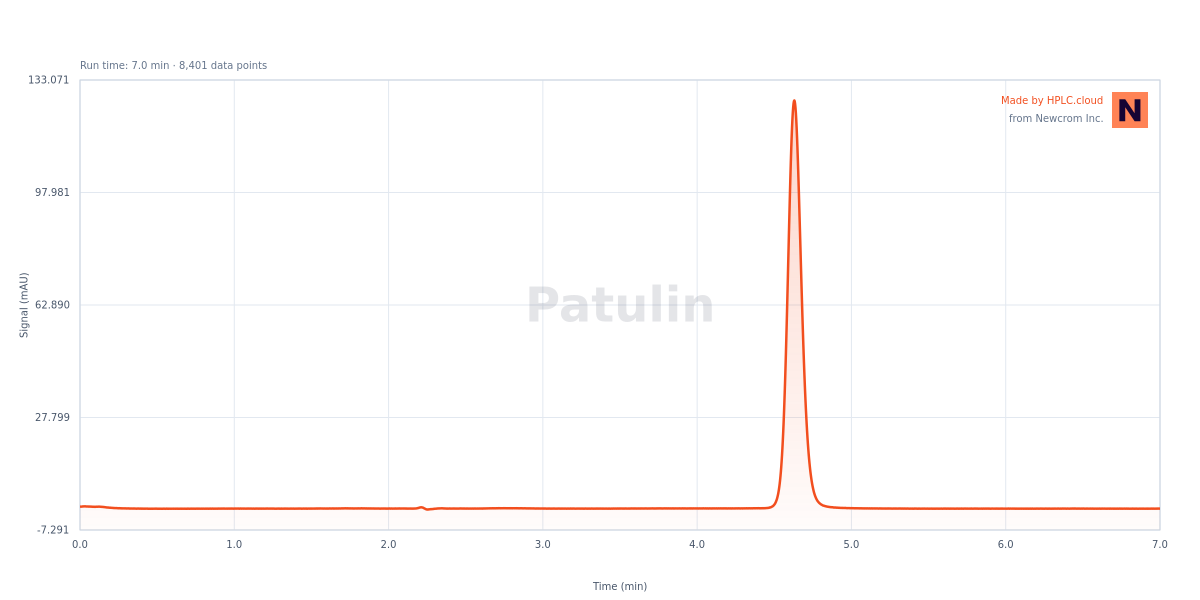
HPLC Method for Analysis of Patulin on Alltesta™ Gradient
Patulin is a fungi produced mycotoxin with the molecular formula C7H6O4. It is lethal to rodents, as well as causing a myriad of health problems to other animals, including rats, mice, chickens, and hamsters. It is typically found on fruits and vegetables, especially apples. Extended exposure to patulin may potentially lead to tumor formation. Patulin can be retained and analyzed using the Newcrom R1 stationary phase column. The analysis utilizes an isocratic method with a simple mobile phase consisting of water and acetonitrile (MeCN) with a ammonium formate buffer. Detection is performed using UV.
Frequently Asked Questions: HPLC Method for Analysis of Patulin on Alltesta™ Gradient
What analyte does the HPLC Method for Analysis of Patulin on Alltesta™ Gradient cover?
The HPLC Method for Analysis of Patulin on Alltesta™ Gradient is designed for Patulin, a mycotoxin compound. Patulin is a fungi produced mycotoxin with the molecular formula C7H6O4.
Which column and mobile phase are required for Patulin analysis?
Run the separation on Newcrom R1 (3.2x150 mm, 5 um, 100A, dual ended), SKU NR1-32.150.0510. Typical mobile phase: MeCN, 10% 10% H3PO4, 0.1%; H2O 90%.
What instrument conditions should I use for the HPLC Method for Analysis of Patulin on Alltesta™ Gradient?
Operate on Alltesta™ Gradient with 275 nm. Flow rate: 0.5. Injection volume: 1. Run time: 7.