HPLC Method for Analysis of Pyridoxine on Alltesta™ Gradient
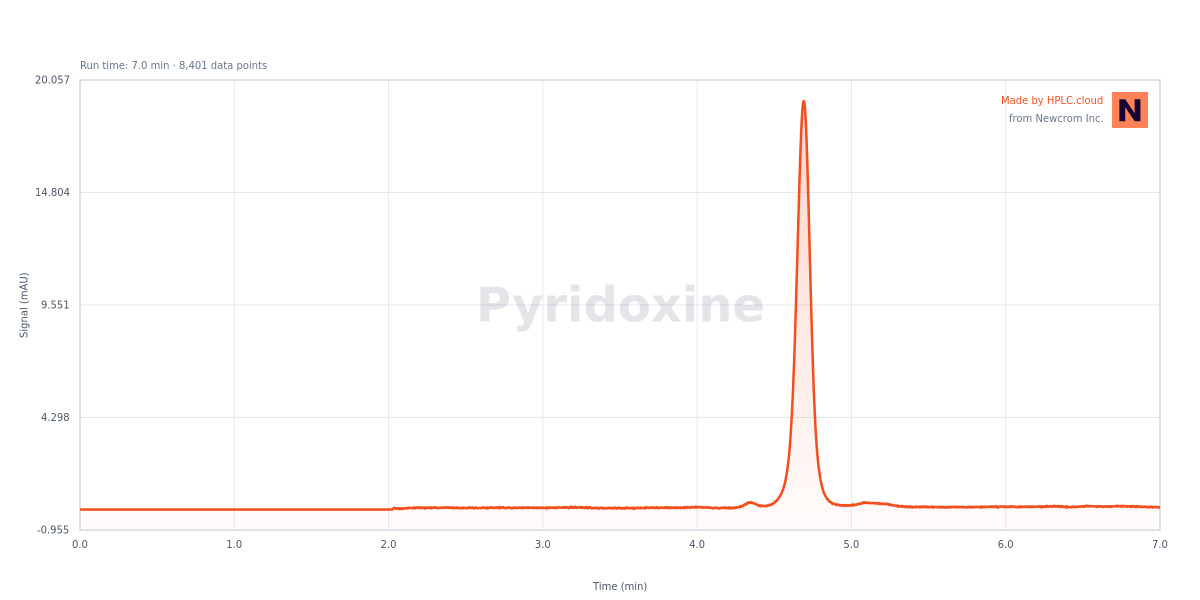
Pyridoxine, also known as Vitamin B6, with the chemical formula C8H11NO3. It is an essential nutrient required by the body to produce red blood cells and for proper nerve functioning. Sources of it include fish, beef liver, chicken, eggs, dark leafy greens, potatoes, chickpeas, cereals, and more. Deficiency of Vitamin B6 can case dermatitis, sores in the mouth, depression, anemia, and seizures. You can find detailed UV spectra of Vitamin B6 (Pyridoxine) and information about its various lambda maxima by visiting the following link. Vitamin B6 (Pyridoxine) can be retained and analyzed using the Primesep 100 stationary phase column. The analysis utilizes an isocratic method with a simple mobile phase consisting of water and acetonitrile (MeCN) with phosphoric acid as a buffer. Detection is performed using UV.
Frequently Asked Questions: HPLC Method for Analysis of Pyridoxine on Alltesta™ Gradient
What analyte does the HPLC Method for Analysis of Pyridoxine on Alltesta™ Gradient cover?
The HPLC Method for Analysis of Pyridoxine on Alltesta™ Gradient is designed for Pyridoxine, a vitamin compound. Pyridoxine, also known as Vitamin B6, with the chemical formula C8H11NO3.
Which column and mobile phase are required for Pyridoxine analysis?
Run the separation on Primesep 100 (4.6 x 150 mm, 5 um, 100 A, dual ended), SKU 100-46.150.0510. Typical mobile phase: MeCN, 50% 50% H2SO4, 0.2%; H2O 50%.
What instrument conditions should I use for the HPLC Method for Analysis of Pyridoxine on Alltesta™ Gradient?
Operate on Alltesta™ Gradient with 275 nm. Flow rate: 1. Injection volume: 1. Run time: 7.